


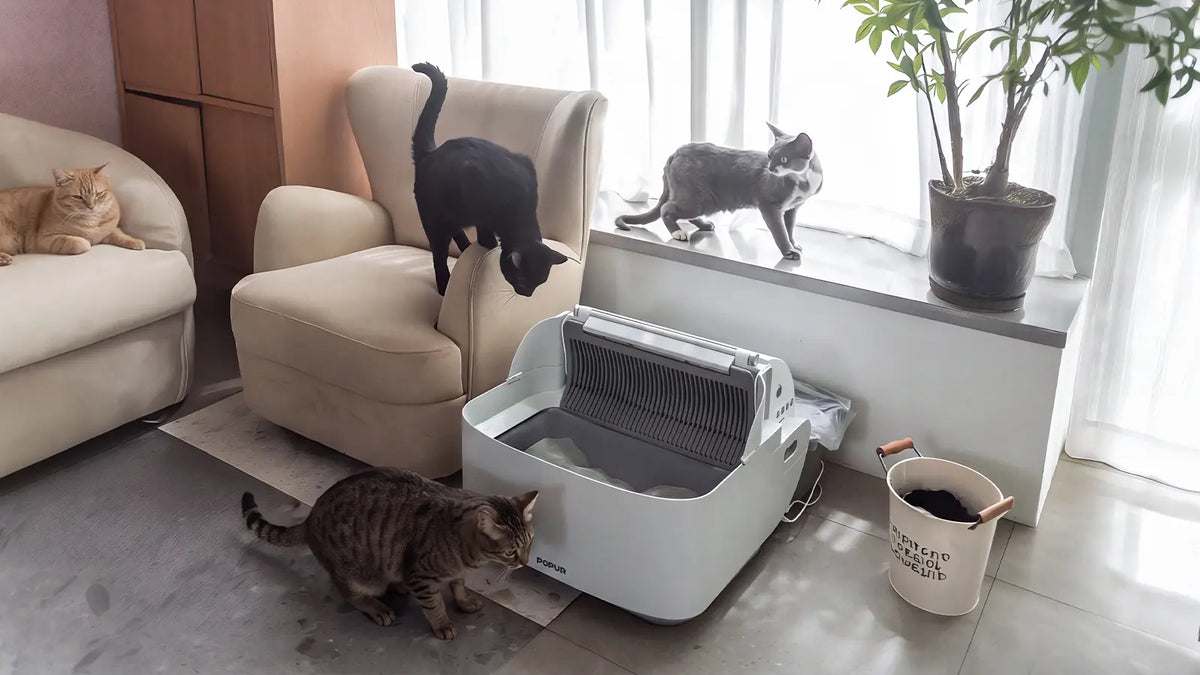
Living with multiple cats often means more litter to manage, more frequent cleanups, and the occasional rush for the same litter box. An automatic litter box can make daily maintenance easier, but choosing one for a multi-cat household involves more than checking how many cats the manufacturer says it supports.
The real questions are whether your cats are comfortable sharing, how quickly the system cleans between visits, and how much attention the litter box will still need as your household grows.
If you're looking for the best automatic litter box for multiple cats, this guide covers what matters in everyday use, how to plan enough litter box access, and why the Popur S7 SLS is designed to handle the demands of a busy multi-cat home.
How Many Litter Boxes Do 2, 3, or 4 Cats Need?
A common veterinary guideline recommends one litter box per cat, plus one extra. The idea is to give cats enough choice and reduce competition over a shared resource.
For a household with three cats, that means planning for four litter boxes rather than expecting every cat to use the same one.
| Number of Cats | General Litter Box Guideline |
|---|---|
| 2 cats | 3 litter boxes |
| 3 cats | 4 litter boxes |
| 4 cats | 5 litter boxes |
| 5 cats | 6 litter boxes |
This is a useful starting point, not a guarantee that every household needs exactly the same arrangement. Cats that get along well may willingly share a preferred litter box, while others need more separation and privacy.
Location matters, too. Several boxes lined up in one corner may not provide the same freedom of access as boxes placed in different quiet areas of the home. A confident cat can still prevent a more timid housemate from approaching a shared litter station.
Does an Automatic Litter Box Change the Rule?
Automatic cleaning helps with one important aspect of sharing: keeping the litter surface cleaner between visits. It doesn't eliminate every reason cats may need separate places to eliminate.
A self-cleaning litter box can reduce scooping and make a frequently used station easier to maintain. However, its waste capacity and the number of cats that can comfortably share a household's available litter boxes are two different considerations.
Think of an automatic litter box as a way to improve the cleanliness and convenience of your setup, rather than a reason to remove every other litter box immediately.
Can Multiple Cats Share an Automatic Litter Box?
Yes. Many cats can share an automatic litter box successfully, particularly when they already tolerate sharing a traditional one.
What matters is how they behave around it.
If one cat consistently waits for another to leave, that's not necessarily a problem. But blocking the entrance, chasing another cat away, or refusing to use a shared box can indicate that the arrangement isn't working for everyone.
The cleaning schedule also matters. A system needs to process waste efficiently without creating unnecessary disruption for the next cat.
Signs That Sharing Is Working
Cats approach the box voluntarily, use it without obvious distress, and continue their normal litter box habits. They can access the area without another cat guarding the entrance.
Watch for changes, especially after adding a new cat or introducing a new machine. Avoidance, elimination outside the box, or repeated conflict deserves attention rather than being dismissed as an adjustment phase.
An automatic litter box may become the household favorite, but keeping another accessible option gives cats more flexibility.
What Matters Most in a Multi-Cat Automatic Litter Box?
The best self-cleaning litter box for multiple cats isn't necessarily the one with the largest exterior or the longest advertised capacity. The following features have a more direct impact on everyday use.
Cleaning Speed Between Visits
In a home with several cats, the litter box may be used repeatedly throughout the day.
Consider how long a cleaning cycle takes, whether the delay before cleaning is adjustable, and what happens when another cat approaches during operation.
A fast cycle can help prepare the litter surface for the next visit, although actual availability also depends on the cleaning delay and the machine's operating settings.
Enough Space for Different Cats
Cats in the same household can vary considerably in size and habits. One may dig vigorously, while another prefers to turn around several times before settling into position.
The usable litter area should accommodate these movements. Entry height and overhead clearance are especially worth checking if your household includes large breeds, senior cats, or cats with different mobility needs.
If you have a Maine Coon or another long-bodied cat, our automatic litter box guide for large cats explains how to evaluate usable space rather than relying on exterior dimensions.
Waste Capacity and Odor Management
More cats generally mean more frequent waste collection. A small waste compartment can quickly become a daily maintenance task, even if the machine cleans the litter automatically.
Compare the usable waste-bin volume, how waste is contained, and how easy it is to replace the bag.
Odor control matters as well. Removing clumps from the litter surface can help, but a waste bin's sealing design, litter quality, cleaning habits, and household conditions all influence the result.
Easy Maintenance and Useful App Controls
A multi-cat automatic litter box will experience more frequent use. Owners should be able to refill litter, check the waste compartment, and clean accessible surfaces without a complicated disassembly process.
App features can also help you understand usage patterns, manage cleaning settings, and notice when the system needs attention.
They're useful tools, but they don't replace checking the litter area or observing your cats directly.
How Much Maintenance Should You Expect?
An automatic litter box reduces manual scooping, but it doesn't eliminate litter box care.
Waste-bin emptying, litter replenishment, and periodic cleaning are still necessary. With more cats, these tasks generally become more frequent.
For example, the Popur S7 SLS has an 11-liter external waste bin. Popur's published capacity estimates illustrate how the number of cats affects the interval between bag changes:
| Household Size | Popur S7 SLS Published Waste-Capacity Estimate |
|---|---|
| 1 cat | Up to approximately 35 days |
| 5 cats | Approximately 7 days |
These are manufacturer estimates, not fixed replacement schedules. Actual intervals depend on each cat's habits, litter type, waste volume, and how the waste accumulates in the bin.
The important takeaway is that a larger waste bin can reduce how often you empty collected waste, but it doesn't mean you can ignore the litter box until the bin is full.
Check the litter level regularly and keep the tray clean. If the waste bin is nearing capacity or odors become noticeable, empty it sooner.

Why the Popur S7 SLS Works Well for Multiple Cats
The Popur S7 Split Litter System (SLS) Edition 2.0 was designed with frequent use in mind. Its combination of an open litter tray, external waste storage, and automated cleaning helps address several of the practical challenges that come with a multi-cat household.
A Separate Waste Bin That Makes Room for More
The defining feature of Popur's Split Litter System is that the litter tray and waste bin occupy separate compartments.
Instead of storing waste beneath or within the cat's enclosed litter chamber, the Popur S7 SLS collects it in an external, sealed 11-liter bin.
That separation allows the litter area to remain open while providing substantial space for collected waste. The bin's design helps utilize its internal capacity and contain waste odors between bag changes.
For households where the litter box receives frequent visits, this means less frequent trips to empty collected clumps.

Ready for the Next Cat in About 2.5 Minutes
The Popur S7 SLS completes a standard cleaning cycle in approximately 2.5 minutes, according to its published specifications.
Its cleaning process separates clumps from reusable litter, transfers waste to the external bin, and smooths the remaining litter bed.
That relatively quick turnaround is useful when several cats prefer the same litter station. Cleaning can also be scheduled or adjusted through the Popur S7 App to suit household routines.
The time between a cat leaving and the next cleaning cycle starting depends on the selected settings, so total turnaround time may vary.
See the Popur S7 SLS in action below to get a closer look at how it sifts, collects waste, and smooths the litter bed in a complete cleaning cycle.
A Familiar Litter Area for Cats of Different Sizes
Not every cat in a multi-cat home has the same build or bathroom habits.
The open-top, tray-shaped design of the Popur S7 SLS provides unrestricted headroom and three-sided access. Without an enclosed rotating drum surrounding the cat, larger cats have more flexibility to position themselves while smaller cats can use the same familiar open litter area.
Its deep litter tray also supports a litter fill depth of up to 4 inches (10 cm), allowing owners to adjust the litter bed to their cats' digging preferences.
Spaciousness is part of Popur's CARESS design philosophy. In a multi-cat household, that approach is especially relevant when a single preferred litter station is used by cats with different physical needs.
Designed for High-Traffic Households
The Popur S7 SLS is rated for shared use by up to 16 cats, with waste bags requiring much more frequent replacement at that level of use.
This figure describes the system's advertised shared-use capacity. It should not be interpreted as veterinary advice to provide only one litter box for 16 cats.
For a typical household with two to five cats, the more practical benefits are the large waste compartment, quick cleaning cycle, and accessible litter area.
The system is also modular, with replaceable components and easily accessible surfaces for routine maintenance—useful considerations for equipment that receives regular daily use.
App Insights for a Busy Cat Household
With multiple cats, it can be difficult to notice changes in litter box habits.
The Popur S7 App provides activity information such as visits, time spent in the litter box, and weight measurements, along with cleaning controls and waste-bin monitoring.

These records can help owners follow usage trends and notice changes worth investigating. Individual-cat attribution depends on the system's identification conditions, so the app should not be treated as an infallible way to identify every visit.

As with any smart litter box, app records are most useful when combined with direct observation, especially if two cats have similar weights or their routines change.
Setting Up a Litter Box Routine for Multiple Cats
Even an automatic system performs best when it fits the way your household actually works.
Start by introducing the new litter box without immediately removing your cats' existing options. Give each cat time to investigate it, and observe whether they approach it voluntarily.
Place litter boxes in quiet, accessible areas where one cat cannot easily trap or block another. In larger homes, distributing them across rooms or floors may be more useful than keeping them all together.
During the first week or two, pay attention to the following:
- Access: Can every cat approach a litter box without being chased or blocked?
- Usage: Are all cats continuing their normal elimination habits?
- Maintenance: How often does the waste bin need emptying, and how quickly does the litter level drop?
- Comfort: Do any cats appear hesitant, rush out, or begin avoiding the area?
If you're evaluating a Popur S7 SLS for multiple cats, these observations will give you a more meaningful picture than a maximum-cat-capacity figure alone.
Keep alternative litter stations available whenever needed. The goal is a cleaner, easier-to-manage routine that still gives every cat comfortable access.
For a real-world look at how cats interact with the Popur S7 SLS, watch the video below.
Frequently Asked Questions
Can multiple cats use the same automatic litter box?
Yes, some cats are comfortable sharing an automatic litter box. Automatic cleaning helps keep the litter surface cleaner between visits, but it's still important to provide enough accessible litter stations and observe whether cats use them comfortably.
What's the best self-cleaning litter box for multiple cats?
Look for a model with sufficient usable litter space, a practical waste-bin capacity, reliable cleaning, manageable maintenance, and controls that suit your household.
The Popur S7 SLS is worth considering for its open-top Split Litter System, 11-liter waste bin, approximately 2.5-minute cleaning cycle, and app-based activity tracking.
How often should I empty an automatic litter box with multiple cats?
It depends on the waste-bin capacity, number of cats, and their individual habits. For reference, Popur estimates that the Popur S7 SLS can hold approximately one week of collected waste from five cats.
Always check the actual waste level and empty the bin earlier when necessary. Regular litter top-ups and cleaning are still part of normal maintenance.
Can an automatic litter box recognize different cats?
Some smart litter boxes provide weight measurements, usage records, and individual pet profiles. The accuracy of identifying a particular cat depends on the device's capabilities and the circumstances of each visit.
The Popur S7 SLS offers pet activity and weight data through its app, but owners should verify identification behavior and use the records alongside their own observations.
What if one of my cats refuses to share?
Don't force the cat to use a shared station. Keep another litter box available in a separate, accessible location and watch for signs of stress or conflict.
If a cat suddenly stops using its normal litter box or begins eliminating elsewhere, consult a veterinarian to rule out medical causes.
Making Litter Care Easier for Every Cat
The best litter box arrangement for multiple cats is one that balances cleanliness with comfort and choice.
Automatic cleaning can reduce the daily workload, particularly when several cats use the same preferred station. Yet the number and placement of litter boxes still matter, and every cat should have an accessible option it feels comfortable using.
The Popur S7 SLS brings together a spacious open tray, a large separate waste bin, quick automated cleaning, and useful app controls. For busy multi-cat homes, these features can make a meaningful difference in everyday litter care.
Explore the Popur S7 Split Litter System (SLS) to learn more about its design, capacity, and features.
Aktie:
Best Automatic Litter Box for Large Cats? A Size & Fit Guide
Are Automatic Litter Boxes Safe? What Cat Owners Should Check